Saturday, October 19, 2019

The Day Money Market Interest Hit 10%

Image result for Money Market

The lending interest in the Money Market hit 10%.  This was not some anti-inflation movement in the 1980s.  It was just last month, September 2019.  It didn't last long and didn't get passed to consumers in their money market accounts.  It did send reverberations throughout the banking world.  Banks in the United States basically ran out of money.  The Federal Reserve of New York pumped $125 Billion into the system to restore liquidity.  

From the lack of headlines, you would think this is something which happens everyday.  It wasn't.  Banks don't usually run out of money.  $125 billion is still a lot of money.  It is the most the Feds have ever released in a quick,emergency fashion. 

The suggestions for going forward from this event are more concerning.  Historically, banks are only allowed to count money as cash reserves.  That is probably why they are called "cash reserves."  However, there is allegedly a movement afoot to allow banks to count bonds, specifically US Treasuries, as cash reserves.  That will allow banks to lend even more money than currently.  If people thought that the credit crisis of the late 2000s was bad, they haven't seen anything yet.  If banks are allowed to lend more based on holdings of Treasury bonds and then run into a cash crunch, the logical step will be to cash those bonds.  That puts the entire US deficit structure at risk.  It could make Treasury bonds near worthless or require the Treasury to put the printing presses on overdrive to pay off the debt.  

The United States government has never defaulted on Treasury bonds.  If the banks start counting them as cash, that day may come.          

Sunday, October 6, 2019

Maine Plows Forward With Ranked Choice Voting

Image result for Ranked Choice Voting

The Maine legislature voted to make it the first state in the United States to use ranked choice voting for presidential electors in general elections.  The 2020 election will be the first in which Maine voters will choose their presidential electors in order of preference.

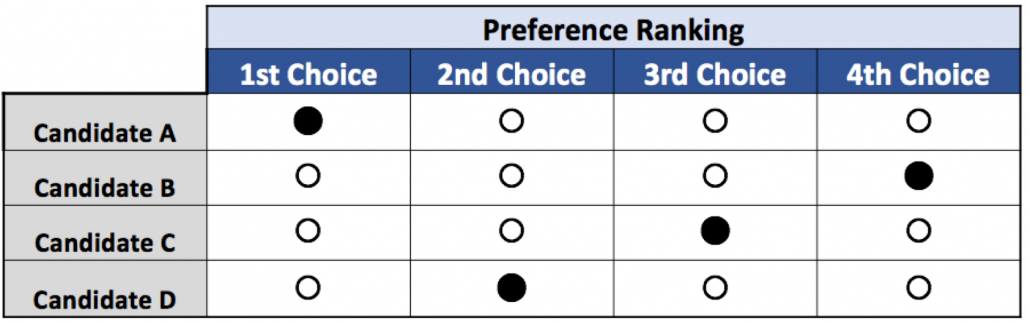
In Maine's version of ranked choice voting, voters rank the candidates from the one they like best to the one they like least.  If no candidate gets more than 50% of the vote, the candidate with the lowest number of first ranked votes is eliminated and the totals of those voters second choices are counted as first choices in the vote totals.  This continues until one candidate gets more than 50% of first and second choice votes.

The hopes of proponents is that ranked choice voting will stop voting for the "lesser of two evils."  If somebody really thinks an independent or alternative party candidate is best, they can vote for that candidate as their first choice and the major party candidate as their second choice without worrying about "stealing" votes from the major party candidate.  In theory, there should also be more consensus, as sometimes a candidate who is the second choice of almost everyone will win over a candidate who is a plurality first choice of 30-40% of the voters.  For example, it is possible that Ross Perot might have won over Clinton and Bush in a ranked choice voting environment, rather than Clinton electors winning with only 43% of the popular vote.  It would have also solved the problem of 2000 Florida presidential election.  

A Conscious Conservative is watching this development.  Although there is guarded optimism, it is believed that Republicans and Democrats can develop a way to rig the ranked choice system also.  Maine is one of only two states that does not select a statewide slate of electors.  We will see if Maine selects any electors that are not pledged to the Republican or Democratic Party in 2020. 

Sunday, September 29, 2019

Is Republican/Democratic Party Collusion Violating Antitrust Law

Related image

According to the Federal Trade Commission website Antitrust Laws--Federal Trade Commission  The Sherman Antitrust Act of 1890 outlaws any "monopolization, attempted monopolization, or conspiracy or combination to monopolize."

In a piece written for The Libertarian Republic , William L. Kovacs argues that Sherman and other antitrust legislation applies to the conspiracy created by the Republican and Democratic Parties against alternative party and independent candidates.  

Kovacs gives a brief description of why antitrust applies and why common arguments against antitrust made by the two major parties are invalid.  He outlines the main legal hurdle as showing how the major parties affect commerce, as most antitrust laws are concerned with restraint of commercial trade.  A Conscious Conservative believes that with the current state of government meddling in markets, this should not be too difficult to show.  The main hurdle will be that almost all judges are aligned with either the Republican or Democratic Party.  I wonder how judges would feel about that as evidence that the two party system is an illegal conspiracy?

Saturday, September 21, 2019

Goldwater Institute Keeps Conservatism Alive

Image result for Goldwater Institute

This week I was pleasantly surprised when I received an annual report in the mail from the Goldwater Institute, About the Goldwater Institute .  Founded over 30 years ago with the blessings of its namesake, Sen. Barry Goldwater, the Institute carries on the fight for conservative principles in the United States.

A Conscious Conservative found the issues outlined in the report refreshing compared to the faux conservatism spouted by Republican politicians and talking heads on television and radio.  Instead of writing about building a wall, there is a remembrance of tearing down the Berlin Wall.  Instead of advocating limits on choices in health care, there were articles about expanding care for both physical and mental disorders through limiting government interference.

Here are a few of the initiatives celebrated in this year's annual report.

The Right to Earn a Living  -- This allows for licensed professionals to practice in another state without being forced to attend school again and go through an entire licensing process anew.

Right to Try--  This allows terminally ill patients to try any drug available to cure their condition, instead of waiting for years or decades of clinical trials and FDA approval.

Right to Free Speech--  The Institute fought against employees being required to pay dues to unions and lawyers being required to pay dues to bar associations when it can be shown that dues money is used to fund political causes.

Property Rights-- The Goldwater Institute is working on various initiatives to curb the use of eminent domain and stop cities from restricting rentals.

As I look at today's headlines on Fox News Politics about personality clashes over the Ukraine, blackface scandals and war with Iran, it reassures me that somebody like the people at the Goldwater Institute still care about the true conservative issues of "limited government, economic freedom and individual liberty..." that affect all of us.  


Saturday, September 14, 2019

Global Tax Cabal Makes Cryptocurrency Its Target

Image result for joint chiefs of global tax enforcement (j5)

The Joint Chiefs of Global Tax Enforcement (j5) is an international agency created by Australia, Canada, the Netherlands, the United Kingdom and the United States.  Their mission, according to the IRS, is to work together to collect taxes worldwide and to fight problems with collecting taxes posed by cryptocurrencies-- IRS-- Joint Chiefs of Tax Enforcement.  The member countries believe that it doesn't matter to where in the world you go or with what means you trade.  You owe them taxes and they will collect by any means necessary.

The latest action by the j5 is that the member countries have agreed to force digital asset exchanges to turn over personal information on their users.  The first member country to do this was the United States, who ordered Coinbase Inc. to turn over their customer database in 2017.  

The arrogance of these countries has been documented throughout history.  However, A Conscious Conservative believes that it is remarkable that they feel they have the right to collect taxes from anyone. anywhere in the world.


Sunday, September 8, 2019

Governments Fight Against Short Term Rentals

Image result for Short Term Rental Ordinances


The internet makes renting out you home or apartment easier and more profitable than ever.  Entrepreneurs are jumping on this trend.  Some see it as more profitable than renting on a long term lease.  Others see it as a way to keep a property in a place where they lived formerly, without letting it be vacant.  Still others see it as an alternative to a timeshare or a way to make owning a vacation home in a trendy area affordable.

This boom in vacation rentals is bringing out the busybodies and government meddlers of all types.  Various local governments are coming up with creative ways to either ban rentals or raise revenue.  

Maryville, Tennessee has banned rentals in all areas zoned residential.

San Bernadino County is debating if people can let other people park RVs on their property.

Newton, Massachusetts wants to regulate whether people can rent rooms in their homes.

Denver makes it a felony to temporarily rent out a home that you cannot prove is your "primary residence."

Portland is pressing companies like Airbnb and HomeAway to share data on its users in order to collect extra lodging taxes.

In a surprise move, the State of New Jersey repealed a special short term rental tax under pressure from the NJ Shore Rental Coalition.

As with all private property rights, government should stay out of it except for clear public health and safety issues.  Most of these laws are driven by lobbying from either the Real Estate or Hospitality industries.  It is another case of where one industry yells foul because government overreach in their industry causes smart entrepreneurs to come up with a creative alternative.  The big losers are the people who can make some extra money from renting out their place and the lodgers who can take a dream vacation on a budget.    


Saturday, August 31, 2019

Housing Costs: The Ignored Inflation

Image result for inflation


Politicians and federal reserve members pat themselves on the back for flooding the economy with money without creating inflation.  They seem to be turning a willful blind eye to one of the most important expenses for average individuals.  Housing.  According to US Census Figures, the median home in the United States has risen to almost $200,000 by 2018.  That is up from about $120,000 in 2000.  According to official inflation data, a median house should be closer to $175,000.  That $25,000 is a large difference, because even with today's low interest rates, it means that the average family will be paying $44,000 extra on a 30 year mortgage.  

Who gets almost 1/2 of that $44,000 extra?  The banks that are pumping extra money into the economy.  Do you think that maybe there is a conflict of interests here?  

The government makes claims of low inflation because people are paying slightly less for electronic components and other consumer items.  Although a person can go without the latest cell phone, just about everybody needs a roof over their head.  So when a politician is telling you that they have pumped trillions of phony dollars into the economy with no inflation, look around your neighborhood for what prices homes have been selling.  You will find the inflation that they claim is lost.  

ARE YOU A CONSCIOUS CONSERVATIVE?

  You may be A Conscious Conservative if you believe: No person or government has a right to take or use a person's property without t...